How to Make Turkey Stock From a Leftover Carcass
 Jessica Williams
In short
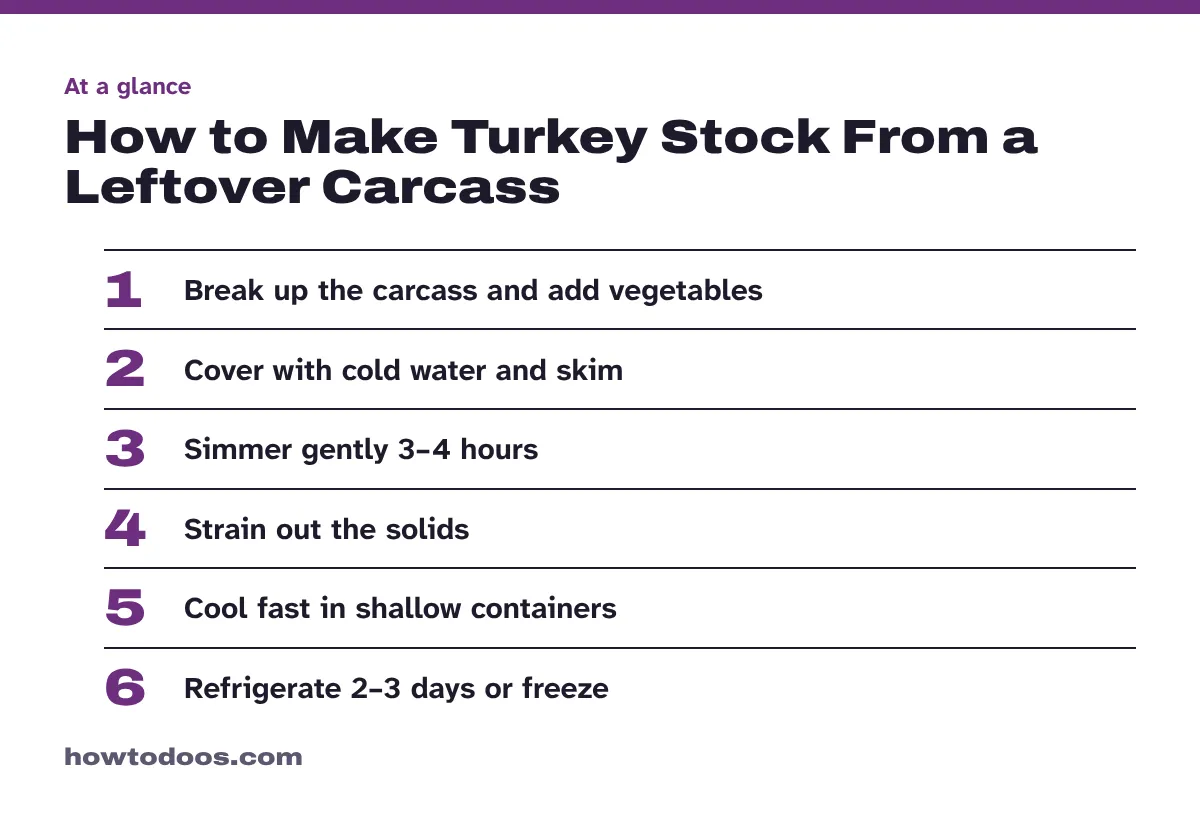
Cover the roasted turkey carcass with cold water, add onion, carrot and celery, simmer gently 3–4 hours, strain, cool fast in shallow containers and freeze.

7 steps in this guide
To make turkey stock, break up the leftover roasted carcass, put it in a large pot with an onion, a carrot and a stalk or two of celery, cover it with cold water and simmer it gently for 3 to 4 hours. Strain out the solids, cool the stock quickly in shallow containers, then refrigerate it for a couple of days or freeze it for months of soups, gravy and risotto.
The cooking method below follows two well-tested recipes, from America’s Test Kitchen and The Kitchn. The cooling and storage rules come from university food-safety extension services, because a big pot of stock is one of the easiest things in the kitchen to cool unsafely.
What you need
- 1 roasted turkey carcass (from a roughly 12–14 lb bird), plus the neck if you kept it
- 1–2 onions, halved (no need to peel)
- 1–2 carrots and 1–2 celery stalks, cut into large chunks
- Optional aromatics: a few garlic cloves, a bay leaf, a teaspoon of black peppercorns, a few sprigs of parsley or thyme
- About 1 gallon (4–4½ quarts) of cold water — enough to cover the bones
- A large stockpot (8–12 quarts), a ladle and a fine-mesh strainer
- Shallow containers and freezer-safe tubs or bags
- A food thermometer for reheating
If the turkey is still mostly whole, start with our guide on how to carve a turkey and save the meat separately — see how to store Thanksgiving leftovers for how long it keeps.
Steps
Step 1: Get the carcass into the pot within a couple of days
Make stock soon. Cooked bones should not sit in the fridge for more than two days before you use them, according to New Mexico State University Extension; if you can’t get to it in time, freeze the carcass in a sealed bag and make stock later.
Pull off any large pieces of meat you want to eat, but don’t strip the frame bare. America’s Test Kitchen warns against a “barren carcass” — the scraps of meat and skin clinging to the bones are what give the stock its flavour.
Step 2: Break up the bones and add the vegetables
Break or cut the carcass into four or five pieces so it fits snugly in the pot and needs less water to cover. Add the neck, the onion, carrot and celery, and any garlic, bay leaf or peppercorns.
Leave out salt for now. Stock reduces as it simmers, and you’ll season whatever you make with it later.
Step 3: Cover with cold water and bring it up to a simmer
Pour in enough cold water to cover everything by an inch or so — about a gallon for a typical carcass. America’s Test Kitchen uses 4½ quarts in a 12-quart pot. Set the pot over medium-high heat and bring it just to a boil.
As it heats, grey foam and fat will rise to the surface. Skim it off with a ladle or large spoon for a cleaner-tasting stock.
Step 4: Simmer gently for 3 to 4 hours
Turn the heat down so only a few bubbles break the surface, and leave the pot uncovered. The Kitchn simmers its stock for 3 to 3½ hours, until it has reduced by about half; America’s Test Kitchen simmers for about 4 hours, adding the fresh herbs halfway through.
Check now and then and top up with a little water if the bones poke out. A hard rolling boil makes stock cloudy and greasy, so keep it gentle.
Step 5: Strain out the solids
Turn off the heat. Lift out the large bones with tongs, then pour the stock through a fine-mesh strainer into a clean pot or large bowl. For an extra-clear stock, line the strainer with cheesecloth or a coffee filter, as The Kitchn suggests. Throw away the bones and spent vegetables.
A typical carcass gives roughly 2 to 3 quarts of stock, depending on how long you simmer it.
Step 6: Cool it fast — don’t put the hot pot in the fridge
This is the step people get wrong. A large container of hot stock placed straight in the fridge “will never cool in a safe amount of time,” according to Michigan State University Extension. MSU’s rule is to get it from 140 °F to 70 °F within two hours, and down to 40 °F within the next four.
To cool it quickly:
- Set the pot or bowl in a sink filled with ice and a little cold water, and stir the stock.
- Then divide it into shallow containers — University of Nebraska–Lincoln Extension recommends no more than two inches deep.
- Put them in the fridge loosely covered, with space around each one for air to circulate, and don’t stack them until they’re cold.
Never leave the stock at room temperature for more than two hours.
Step 7: Skim the fat, then refrigerate or freeze
Once chilled, the fat sets in a layer on top. Lift it off with a spoon (you can save it to make gravy or roast potatoes).
Use refrigerated stock within about 3 days — NMSU gives “up to about 3 days” and America’s Test Kitchen says up to 2, so sooner is better. For longer storage, freeze it in portions at 0 °F; NMSU calls freezing the safest option and says quality stays best for several months. Leave some headspace in each container because liquid expands as it freezes, and label each one with the date.
When you use it, bring the stock to a boil or heat it until steaming hot throughout, at least 165 °F.
Tips
- Freeze in useful sizes. One- and two-cup tubs suit soups and gravy; an ice-cube tray gives small portions for pan sauces.
- Roast for a darker stock. If the carcass is pale, roast the pieces on a sheet pan until browned before they go in the pot.
- Add herbs late. Delicate herbs like parsley and thyme lose their flavour over hours, so add them for the last hour or so.
- Season at the end. Salt the soup or gravy you make, not the stock itself.
Troubleshooting
- Cloudy stock: it boiled too hard or wasn’t skimmed. It’s still fine to eat; strain it through cheesecloth for a clearer result next time.
- Weak, watery flavour: too much water or too little meat on the bones. Simmer the strained stock uncovered to reduce it and concentrate the taste.
- Stock turned to jelly in the fridge: that’s a good sign — it’s gelatine from the bones, and it melts back to liquid when heated.
- Forgot it on the stove overnight: discard it. Stock that has sat in the danger zone (40–140 °F) for hours isn’t safe, even if you reboil it.
FAQ
How long should you simmer turkey stock?
Between 3 and 4 hours at a gentle simmer. The Kitchn simmers for 3 to 3½ hours until reduced by about half, and America’s Test Kitchen for about 4 hours.
How long does homemade turkey stock last in the fridge?
About 2 to 3 days. New Mexico State University Extension says up to about 3 days for properly cooled broth in an airtight container; freeze anything you won’t use by then.
Can you freeze turkey stock?
Yes. Freeze it in portions at 0 °F, leaving headspace for expansion. NMSU Extension says frozen broth keeps its best quality for several months.
Should you put hot stock straight in the fridge?
Not in the big pot. Cool it first in an ice bath and shallow containers, aiming to get it below 70 °F within two hours and below 40 °F within six, as Michigan State University Extension advises.
What is the difference between turkey stock and broth?
Stock is usually made mainly from bones, which gives it body from gelatine, while broth is usually made mainly from meat. At home the words are often used interchangeably, and both work the same way in recipes.
Conclusion
A leftover turkey carcass, a few vegetables and an afternoon of gentle simmering give you quarts of rich stock for the winter. The cooking is forgiving; the part to take seriously is cooling it quickly in shallow containers and getting it into the freezer within a few days.