How to Keep a Real Christmas Tree Fresh – Step-by-Step Guide
 Emily Carter
In short
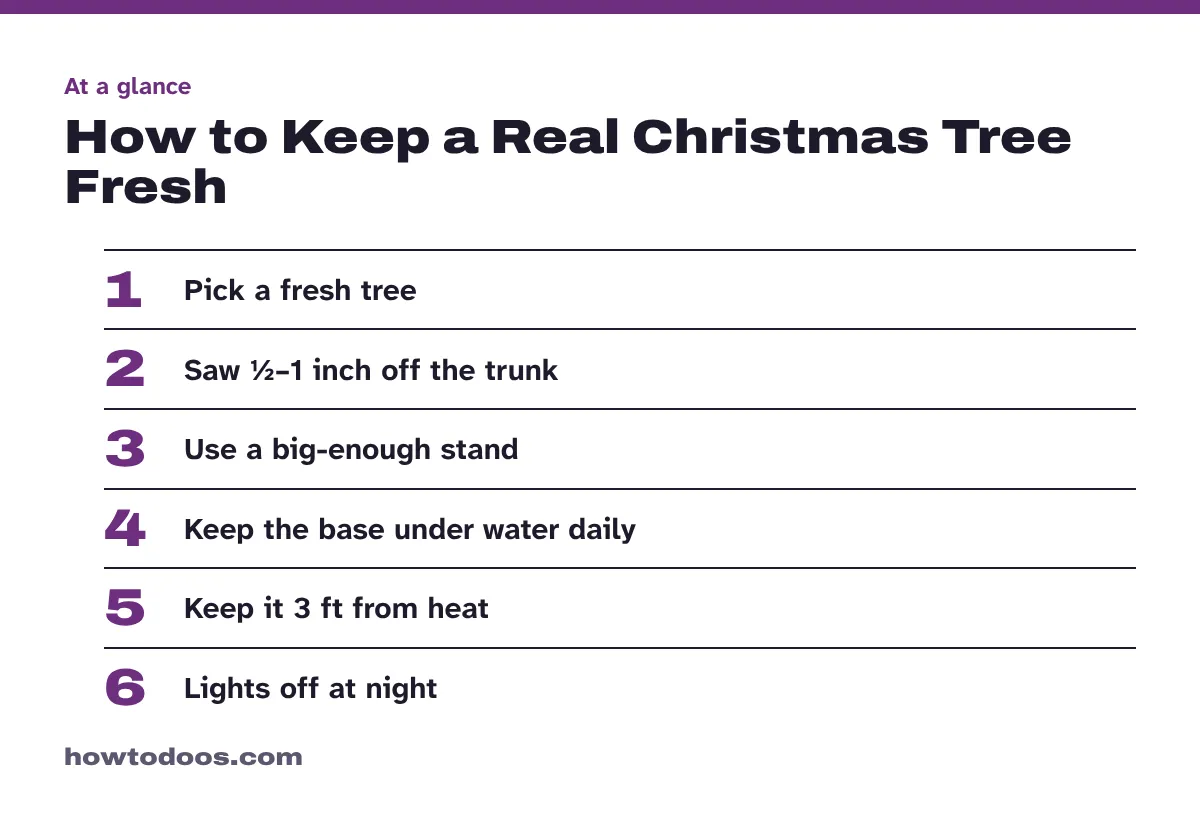
Cut ½–1 inch off the trunk just before it goes in the stand, use a stand that holds 1 quart of water per inch of trunk, keep the base under water daily, away from heat.

8 steps in this guide
- Pick a fresh tree
- Store it in water if you’re not setting it up yet
- Make a fresh cut just before it goes in the stand
- Choose a stand big enough to hold the water it needs
- Water every day and keep the base covered
- Place it away from heat and use low-heat lights
- Switch the lights off and keep checking freshness
- Take it down before it gets dry
To keep a real Christmas tree fresh, saw a fresh straight cut off the bottom of the trunk right before it goes in the stand, use a stand that holds about 1 quart of water for every inch of trunk diameter, and check every day that the water covers the base of the trunk. Keep the tree away from heat sources and use low-heat lights. Plain tap water is all it needs, and a well-watered tree can stay green for weeks.
The advice below comes from the National Christmas Tree Association’s tree care tips, Michigan State University Extension’s guide to making your real Christmas tree last, University of Illinois Extension’s page on caring for live Christmas trees, and the NFPA’s Christmas tree safety tip sheet. Freshness matters for more than looks: a dry tree burns far more easily than a well-watered one.
What you need
- A fresh-cut tree (see Step 1 for how to check)
- A tree stand that holds at least 1 quart of water per inch of trunk diameter — for most family-size trees that means a stand holding 1 gallon or more
- A pruning saw or bow saw
- A tape measure to check the trunk width
- A watering can or jug with a narrow spout
- Miniature or LED lights listed by a recognized testing laboratory
- An old sheet or tree bag to carry it in and out
Steps
Step 1: Pick a fresh tree
Start with a tree that hasn’t already dried out. Mississippi State University Extension suggests a few quick checks: a pile of dropped needles at the base is a bad sign, and if needles come off when you pull a branch gently toward you, or a twig snaps instead of bending, the tree is dry. MSU Extension’s version of the test is to gently pull on a shoot — on a fresh tree, no needles should come off in your hand.
If you cut your own at a farm, you’ll know exactly how fresh it is. On a retail lot, ask when the trees arrived and choose one that’s been kept in a shaded spot.
Step 2: Store it in water if you’re not setting it up yet
If the tree is going to wait in the garage or on the porch for a few days, don’t leave it lying dry. Illinois Extension advises making a fresh one-inch cut and standing the trunk in a bucket of water in a cool, sheltered place. The NCTA says a tree can be stored this way for several days, as long as the bucket stays full.
Step 3: Make a fresh cut just before it goes in the stand
When the trunk is cut, sap (resin) gradually seals the end and stops it drinking. So the last thing you do before setting the tree in the stand is saw a fresh disk off the bottom.
How much to take off varies a little by source: the NCTA says about ½ inch, MSU Extension says ½ to 1 inch, and Illinois and Mississippi State extensions say about 1 inch. Taking off ½ to 1 inch covers all of them.
Keep the cut straight across the trunk. The NCTA specifically says not to cut it at an angle or into a V shape, not to drill a hole in the base (it “does NOT improve water uptake”), and not to whittle the sides of the trunk down to squeeze it into a stand that’s too small — the outer layers are the ones that take up water best.
The NCTA notes that most species can still take up water 6 to 8 hours after the trunk is cut, but sooner is better. Get the tree into water as soon as you can.
Step 4: Choose a stand big enough to hold the water it needs
Measure across the trunk where you made the cut. The NCTA’s rule of thumb is 1 quart of water per inch of stem diameter, so a 4-inch trunk needs a stand that holds at least a gallon. Illinois Extension recommends a stand that holds at least one gallon, and Mississippi State suggests one that holds 1–2 gallons.
Set the tree in the stand, tighten the bolts evenly so it stands straight, and fill the stand with water straight away.
Step 5: Water every day and keep the base covered
A fresh tree drinks a lot, especially in the first few days. MSU Extension says a tree can use up to 1 quart of water per day for each inch of trunk diameter — for example, up to 3 quarts a day for a 7-foot tree with a 3-inch trunk — and that heavy drinking is a sign the tree is fresh. Mississippi State notes trees can use up to 2 gallons a day early on.
Check the stand at least once a day and top it up. The key point: the water must stay above the bottom of the trunk. The NCTA warns that a stand can still have water in it while the base of the tree is no longer submerged, and if the cut end dries out, resin seals it and the tree stops drinking.
Use plain tap water. MSU Extension says not to add sugar, aspirin, bleach or floral preservatives, because research shows plain tap water is all that’s needed. Illinois Extension agrees that additives aren’t necessary. The NCTA adds that water temperature doesn’t affect uptake.
Step 6: Place it away from heat and use low-heat lights
Heat dries a tree out quickly. The NCTA recommends keeping trees away from fireplaces, heaters, heat vents and direct sunlight, and notes that a cooler room slows drying. The NFPA’s tip sheet is more specific: keep the tree at least three feet from any heat source, such as fireplaces, radiators, candles, heat vents or lights, and make sure it doesn’t block an exit.
For lighting, use miniature or LED lights, which give off less heat. The NFPA says to use lights listed by a qualified testing laboratory, replace any string with worn or broken cords, and never use lit candles on the tree. For outdoor and indoor light setup, see our guide on how to hang Christmas lights safely.
Step 7: Switch the lights off and keep checking freshness
Turn the tree lights off when you go to bed or leave the house — the NFPA, NCTA and both extension services all give this advice. A plug-in timer makes it automatic.
Every few days, repeat the freshness check from Step 1. If needles shower down when you brush a branch or twigs snap, the tree is drying out.
Step 8: Take it down before it gets dry
Illinois Extension says many fresh-cut trees that are properly cared for will last at least five weeks before drying out, and advises taking the tree down before that happens. The NFPA says to get rid of the tree after Christmas or when it is dry, and not to leave a dried-out tree in the house or garage or propped against the outside of your home. Never burn any part of it in a wood stove or fireplace (NCTA) — check with your city or county for a tree recycling or curbside pickup program instead.
Tips
- Buy timing: if you want the tree up all December, buy from a lot with fresh deliveries or cut your own, and keep it in water outside until you’re ready.
- Let it settle: bring the tree in and let the branches drop overnight before decorating; it gives you time to confirm it’s drinking.
- Protect the floor: put a waterproof mat or tray under the stand so top-ups don’t damage the floor.
- Keep a jug nearby: a filled jug next to the tree turns the daily top-up into a 10-second job.
- Pets and kids: a stand with a covered reservoir stops pets drinking the water and keeps small hands out.
Troubleshooting
The water level isn’t dropping. The cut end may have sealed over with resin — usually because the base dried out, even briefly. Take the tree out, saw another fresh disk off the bottom, and put it straight back into water.
Needles are falling fast. Some needle drop from the inside of the tree is normal, but heavy drop with brittle twigs means the tree is dry. Check the water level, move it further from heat vents and sunny windows, and plan to take it down soon.
The trunk won’t fit the stand. Get a bigger stand rather than shaving the trunk. The outer layers of wood carry the most water, so trimming them hurts uptake.
The stand leaks. Empty it, check the reservoir for cracks, and replace it if needed — a leaking stand won’t keep the base covered.
FAQ
How do you keep a Christmas tree from drying out?
Give it a fresh straight cut of about ½–1 inch right before it goes in the stand, use a stand that holds 1 quart of water per inch of trunk diameter, check daily that the water covers the base, and keep the tree away from heat sources and direct sunlight.
Should you put sugar or aspirin in Christmas tree water?
No. MSU Extension says not to add sugar, aspirin, bleach or floral preservatives, because research shows plain tap water is all a cut tree needs. Illinois Extension also says additives aren’t necessary.
How long does a real Christmas tree last indoors?
According to Illinois Extension, many fresh-cut trees last at least five weeks if properly cared for. How long yours lasts depends on how fresh it was when you bought it, how well it’s watered and how warm the room is.
How much water does a Christmas tree need per day?
A fresh tree can use up to 1 quart of water per day for each inch of trunk diameter, according to MSU Extension, and the most in the first few days. Check the stand at least once a day.
Do you need to cut the bottom of a Christmas tree?
Yes, unless it was cut within the last few hours. The cut end seals with resin over time, so a fresh straight cut just before you put it in the stand lets the tree take up water. Don’t drill holes or cut it at an angle.
Conclusion
A real Christmas tree stays fresh for most of the season if you get three things right: a fresh straight cut just before it goes in the stand, a big enough stand that you top up every day so the base never dries out, and a spot well away from heat. Skip the additives, use low-heat lights and switch them off at night, and take the tree down before it turns dry and brittle.