How to Hang Christmas Lights Safely – Step-by-Step Guide
 Emily Carter
In short
Use lab-tested lights rated for where they'll go, inspect every strand, plan the run to a GFCI outlet, hang with plastic clips from a sound ladder, and switch off at night.
7 steps in this guide
To hang Christmas lights safely, start with lights tested by a recognized safety lab and rated for indoor or outdoor use as needed, check every strand for damage, plan your run to a GFCI-protected outlet, then fasten the lights with plastic clips while working from a sound wooden or fiberglass ladder. Switch everything off when you go to bed or leave home. An afternoon of careful setup gives you a display that looks tidy and lasts the whole season.
The safety steps below come from the U.S. Consumer Product Safety Commission’s holiday decorating advice, the Electrical Safety Foundation International’s outdoor decoration safety tips, and the Illinois State Fire Marshal’s winter holiday safety page. Falls are a real risk here: in that release, CPSC reported about 14,700 emergency-room visits for holiday decorating injuries in a single season, and falls made up 41% of them.
What you need
- Light strands with a safety lab’s mark (such as UL, ETL or CSA), rated “indoor”, “outdoor” or both to suit where they’ll go
- Outdoor-rated extension cords with an amp rating that covers your lights
- A GFCI-protected outdoor outlet, or a portable outdoor GFCI
- Plastic light clips for gutters, shingles or railings (no nails or staples)
- A wooden or fiberglass ladder in good condition, and a helper to steady it
- A tape measure, a notepad and a plug-in timer (optional but handy)
- Spare bulbs and fuses from the light set’s packaging
Steps
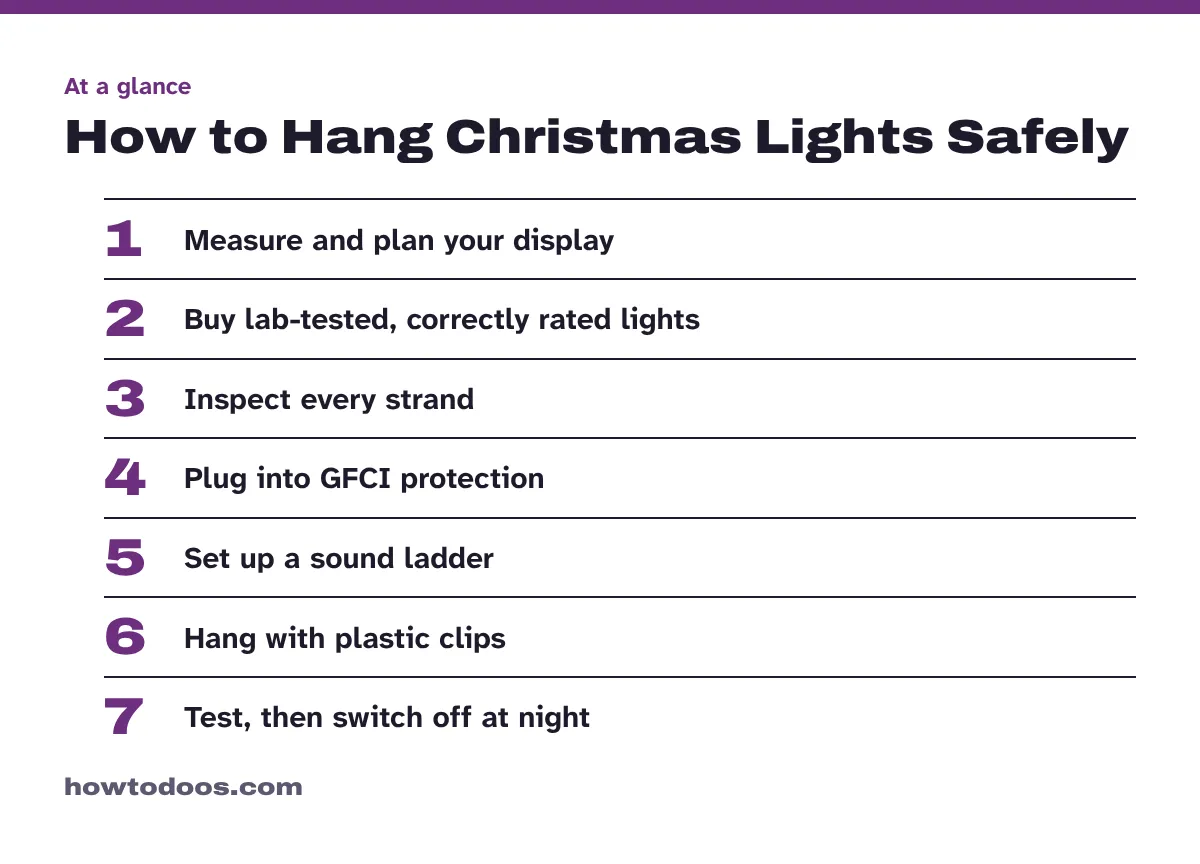
Step 1: Measure and plan your display
Walk around the house and measure each run you want to light: the roofline, gutters, windows, porch railing, shrubs. Note where the nearest outdoor outlet is and how far each run is from it. This tells you how many strands and how much extension cord to buy, and it stops you from improvising with indoor cords on the day.
Check the light set’s packaging or instructions for how many strands you can connect end to end. The Illinois State Fire Marshal tells you to “read the recommendation for number of light strings you can string together”. For older incandescent sets, an NFPA guideline reposted by Connecticut’s fire commission is no more than three strands of mini lights, or a maximum of 50 bulbs for screw-in bulbs; for LED sets, go by the manufacturer’s number.
Step 2: Buy lights and cords rated for the job
CPSC’s advice is to “only use lights tested for safety by a nationally recognized testing laboratory.” Look for that lab mark on the box and the cord tag. Then check the rating: some lights are made for indoor use only, some for outdoor use only, and some for both. Anything going on the house, in the yard or on a porch must say it’s for outdoor use, and so must every extension cord you use outside.
ESFI also recommends matching the power your decorations need with the extension cord’s amperage rating. If you’re unsure, compare the watts or amps listed on the light sets with the rating printed on the cord.
Step 3: Inspect every strand before it goes up
Plug each strand in on the floor or a table and check it lit, before you climb anywhere. Unplug it, then run it through your hands and look for:
- Broken or cracked sockets
- Frayed, bare or pinched wires
- Loose bulb connections
- Missing bulbs (replace them with the type listed on the packaging)
CPSC says to check every set, new or old, and throw out damaged ones rather than taping them up. Check your extension cords the same way. Always unplug a strand before you swap a bulb or fuse.
Step 4: Plug into GFCI protection
A ground-fault circuit interrupter (GFCI) cuts the power fast if current leaks somewhere it shouldn’t, such as through water. Both CPSC and ESFI say outdoor lights should be plugged into a GFCI-protected outlet. Many outdoor outlets already have one; look for the “Test” and “Reset” buttons on the outlet or on a nearby indoor outlet on the same circuit. If you don’t have one, ESFI notes that portable outdoor GFCIs are sold for this and need no special installation.
Don’t plug too much into one outlet, and keep plugs and connections off the ground where snow and standing water collect. Never run cords through a closed door or window, where they can get pinched.
Step 5: Set up your ladder safely
Inspect the ladder for loose or missing screws, hinges, bolts and nuts. ESFI recommends wooden or fiberglass ladders because metal ladders conduct electricity, and says an extension ladder should reach at least three feet past the edge of the roof. Set it on firm, level ground, ask someone to hold the base, and move the ladder rather than leaning out to reach.
Look up before you start. ESFI says to keep yourself and your equipment at least 10 feet from power lines, so skip any section of roofline near the service drop to the house.
Step 6: Hang the lights with clips
Start at the end nearest the outlet so the plug ends up where your cord can reach it. Clip the strand along the gutter, under shingle edges or along the railing every foot or so, keeping it straight and taut but not stretched.
ESFI’s advice is to fasten lights securely but “not to attach the lights in a way that could damage the cord’s insulation”. That’s why plastic clips beat nails, tacks and staples, which can pierce the wire. Wrap trees and shrubs loosely so branches can move in the wind without pulling the strand.
Indoors, NFPA advises keeping a real Christmas tree at least three feet from any heat source, and the Illinois State Fire Marshal says to check that decorations are flame retardant or flame resistant. Don’t put electric lights on a metallic tree, which CPSC warns against.
Step 7: Test the display and turn it off at night
Once everything is up, plug in and check each run. If a section is dark, unplug before you look for a loose bulb or blown fuse. Then make a habit of switching off: ESFI says to turn off all indoor and outdoor electrical decorations before leaving home or going to sleep. A plug-in outdoor timer makes this automatic.
Tips
- Hang lights on a dry, calm day. Wet roofs and gusty wind make ladder work far riskier.
- Label your strands. A strip of masking tape on each plug (“porch left”, “gutter front”) makes next year’s setup faster.
- Keep spotlights ventilated. ESFI says spotlights need to be weather-protected and kept a safe distance from anything that can burn.
- Take lights down carefully. Wind each strand around a piece of cardboard so it doesn’t tangle or kink, and store it somewhere dry.
- Getting the house ready for winter anyway? Pair this job with winterizing your outdoor faucets while you’re outside.
Troubleshooting
Half the strand is out. On many incandescent mini-light sets, one loose or broken bulb can darken a section. Unplug the strand and push each bulb in that section firmly into its socket, replacing any that look burnt.
Nothing lights at all. Check whether the GFCI has tripped and press “Reset”. Then check the small fuses in the plug of the first strand (unplugged); spares usually come in the box.
The GFCI keeps tripping. That usually means moisture or a damaged cord or connection somewhere in the run. Unplug everything, dry and inspect the connections, and keep them raised off wet ground. Replace any damaged strand.
FAQ
Is it safe to leave Christmas lights on overnight?
Safety organizations say no. ESFI and the Illinois State Fire Marshal both advise turning off light strings and decorations before you go to bed or leave home. A timer is the easiest way to do this every night.
Can I use indoor Christmas lights outside?
Not unless the packaging says they are rated for outdoor use. Lights and extension cords used outside should be marked for outdoor use, and CPSC also advises plugging outdoor lights into a GFCI-protected outlet.
How many strings of Christmas lights can I connect together?
Check the light set’s instructions, which state the maximum. NFPA’s long-standing guideline is no more than three strands of incandescent mini lights; LED sets often allow more, but use the manufacturer’s number rather than guessing.
Should I use nails or staples to hang Christmas lights?
No. Nails and staples can puncture the cord’s insulation, which ESFI warns against. Plastic gutter and shingle clips hold lights firmly and come off without damage.
When should I put up outdoor Christmas lights?
There’s no official date. Hanging them early, on a dry, mild day before snow and ice arrive, makes the ladder work safer, and you can wait to switch them on until you’re ready.
Conclusion
A safe light display comes down to the right gear and a few habits: lab-tested lights rated for where they go, damaged strands thrown out, outdoor cords plugged into GFCI protection, plastic clips instead of nails, and a solid ladder well away from power lines. Set a timer, switch everything off at night, and you can enjoy the glow all season without worry.